
Camper Van Solar: What Can It Run?
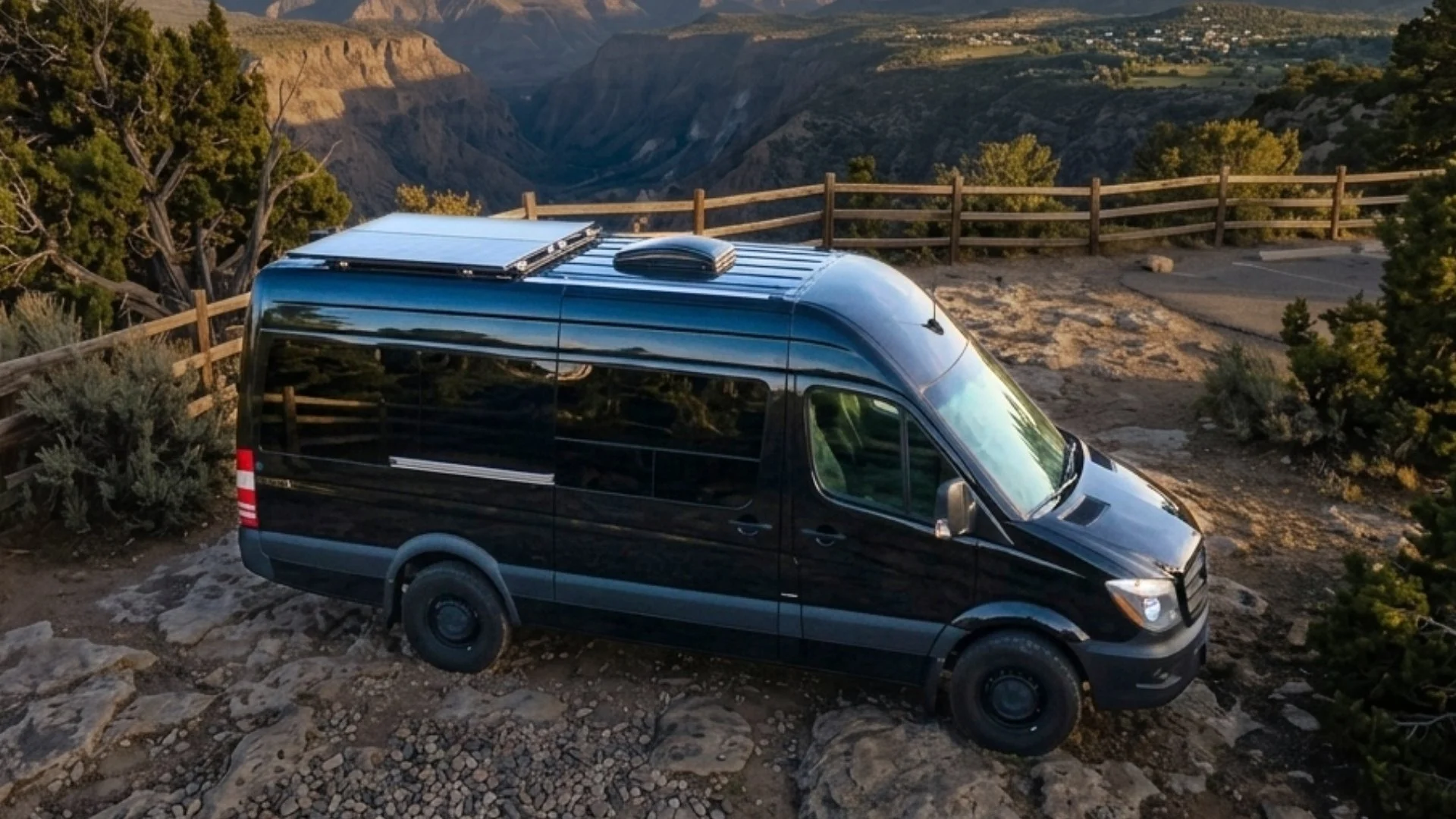
Before We Start: Solar, Itself, Doesn't Run Anything
People ask us all the time what solar can power in a camper van. It is an understandable question, but it's not the right way to think about solar. Solar panels do not run your fridge, your lights, or your laptop. Your batteries do. Solar is simply one way to recharge those batteries, and in most van setups, it is the smallest source of charging you have.
Typically, your van's alternator puts energy back Into your battery while you drive. Shore power (if the van is equipped and plugged into an outlet at a campground or at home) charges the batteries quickly. Solar helps keep things topped off in between. That is its job. Not to power everything, but to slow down how fast the batteries drain when you are parked.
Once you understand that, the rest of the decisions get simpler.
Your Electrical System in Plain Terms
Your van's electrical system has two sides: storage and usage.
Storage is your battery. It holds a certain amount of energy, measured in amp hours. A 100 amp hour battery can deliver 5 amps for 20 hours, or 10 amps for 10 hours. The bigger the battery, the longer you can go before it needs recharging.
Usage is what you are running. Your fridge, your lights, your fan, your phone charger. Each one pulls from that battery at a different rate.
Then there is a third piece that sits alongside those two: charging. How do you put energy back into the battery to keep up with what you are using?
As mentioned above, there are three ways:
Alternator charging while you drive (through a device called a DC-to-DC charger)
Shore power
And solar
Most systems that work well over time have all three available rather than depending on any single one.
One note: You will sometimes see battery capacity described in watt hours instead of amp hours. Watt hours is simply amp hours multiplied by the voltage of your battery, typically 12V. A 12V battery that's rated at 100 amp hours of storage has 1200 watt hours of total stored energy. It is the same amount of energy described with a bigger number. We find amp hours easier to work with, and that is what we will use here.
Do You Even Need Solar?
This depends on how you use the van.
If you drive every day, or plug into shore power at campsites, your alternator and shore power are doing the heavy lifting. Solar might not add much value to your setup. That is an honest answer a lot of content out there will not give you, because most of it is written by companies wanting to sell solar systems.
If you spend more than a day or two parked in one spot without plugging in, solar starts to earn its place. It most likely will not fully replace what you use, but it can slow the drain enough to stretch your time between charges.
And if you are regularly boondocking for extended stretches, solar goes from nice to have to something you will want as much of as you can fit.
How Much Solar Can You Actually Install?
This is the more useful question, and the answer is simpler than most people expect: you put as much as your roof allows and call it good.
Van roofs are smaller than people think once a fan and any roof rack crossbars are accounted for. A Toyota Sienna typically carries a single 230 watt flexible panel, and that is about all the roof allows. Larger vans have more room, but even a full-size Transit or ProMaster tops out well below what a house roof can hold.
The good news is that solar panels are not a prohibitively expensive part of the electrical system. If you have the roof space, there is little reason not to fill it. You are not going to oversize your solar in a van. The available area is the limitation.
How Long Can You Go Without Shore Power?
There is no single answer, but the arithmetic is simple once you know your usage.
A DC fridge is usually the biggest steady draw in a camper van. A typical one pulls around 4 to 5 amps per hour. At 5 amps, a 100 amp hour battery would run that fridge for 20 hours on its own with no charging at all. Lights and phone charging barely register. A fan is modest.
That gives you a baseline. From there, the variables are how much sun your panels are getting (which changes with the season, your latitude, and whether you parked in the shade), how much driving you are doing (alternator charging is often the biggest recharge source for people who move every few days), and whether you are plugging in anywhere along the way.
The honest answer for most people is that a well-sized battery with solar handles a couple of days parked without much thought, especially if you are driving between stops and the alternator is topping you off along the way. Beyond that, you start managing the battery more carefully, and that is usually the sign that it is time to think about capacity.
We will get into the actual math in a future post. For now, knowing the basics is enough to have a good conversation with your builder about what your system needs to look like.
What People Wish They Had Done
Most van-buying advice warns against building a larger electrical system than you need. That is not the pattern we see.
What people come back to talk about is what they left out. What we hear most often is they regret not installing an inverter, which is the component that makes it possible to plug in your household 110 volt appliances. Some left it out completely and some installed one that was undersized.
In both cases the decision was usually about cost, and in both cases they often come back two or three years later, which costs more in total because the work gets done twice. Retrofitting an inverter or a larger battery usually means pulling out cabinetry that was built around the original components.
The same goes for battery capacity. Erring toward the smaller option and hoping it covers the use is the most common way people end up spending more.
When It Makes Sense to Upgrade
Electrical systems age in ways that are easy to miss because they degrade rather than fail. A battery that held a full day of use when it was new holds less after several years of cycling, and the change is gradual enough that people adapt to it without noticing.
A few cases that tend to call for a look:
Your use changed. The most common one. A van built for weekends gets used for a month at a time, or someone starts working from it, or a bigger fridge gets added along the way. Any new load on a system sized for the old load changes the equation.
You are working around the system. Turning things off to run other things, or planning around charge state. A system you have to manage carefully tends to be undersized for how you are living with it.
The battery is old. AGM batteries (absorbed glass mat, the older lead-acid type) tend to give around five years of service, lithium closer to seven to ten. If you are noticing shorter runtime, a battery replacement is usually the right call.
Not every one of these calls for a full rebuild. The three we do most often are a battery upgrade from AGM to lithium, replacing or adding solar, and adding an inverter to a van that was built without one. We do this work on vans other shops built as well as our own.
Where This Leaves You
If you are early in planning a build, the useful thing to work out is how you will use the van, how long you want to be able to go without plugging in, and where you will be doing that. The answers to those three questions determine the size of the battery, the inverter, and the panels, roughly in that order of importance.
For solar specifically: fill what your roof allows, make sure you have alternator charging too, and do not overthink the panel specs. The panels are the easy part. The battery and the inverter are where the real decisions live.
Want to talk it through?
If you've been thinking about a pop-top, the best next step is a conversation about your specific van. The platform, the year, how you plan to use it, whether it needs to fit in your garage. Those details shape everything from the timeline to the cost.
Most of these conversations start the same way: "Here's what I'm working with. What makes sense?" That's the right place to start.
Call us at 888-332-9602 or send us a message here
Stay in the loop
Our newsletter is where we share what we're learning, thinking about, and building at the shop. Platform insights, practical advice, and the kind of detail that tends to matter more over time.
No hype. No spam. Just useful perspective from people who do this every day.
Subscribe to the GTRV newsletter
If you're still in research mode, these are good next steps:
High Roof vs Pop Top: How to Decide
