
How to Choose the Right Camper Van
If you’ve been thinking about a camper van and comparing platforms like the Sprinter, Transit, ProMaster, or Sienna, you’ve probably started with some version of the same question most people ask first: “What’s the best van for a camper conversion?”
That question usually leads to a more useful one. Which van actually fits the way you plan to use it?
At GTRV, we build camper vans every day. We hear the same questions come up again and again. Not about specs or rankings, but about real use. How it drives, how it feels on a long day, what kind of trips it handles well, and what starts to feel limiting after a year.
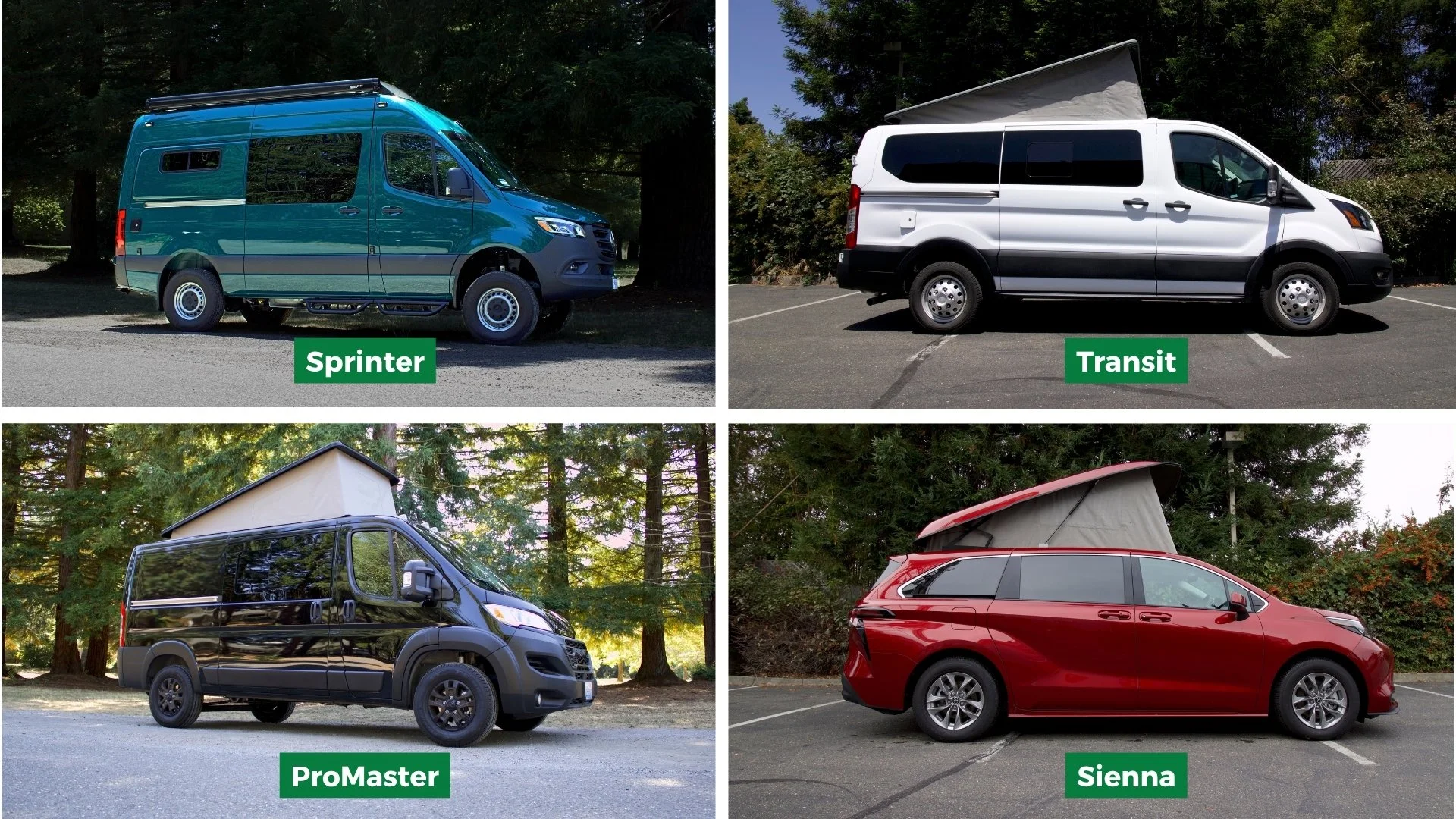
This guide is a practical walkthrough of the four platforms people ask us about most and why someone might choose one over another. There isn’t a single right answer, but there are usually a few wrong ones for a given situation.
If you’re still early in the process, this should help you narrow the field. Not so you can decide right away, but so the next questions you ask are the ones that actually matter for how you’ll use the van.
Full-Size Vans
Ford Transit
Most people think of the Sprinter first. It has more name recognition, and it’s usually what shows up first online. But after working on all of these platforms for years, the Transit is the one we tend to point people toward, based on how they actually end up using their vans.
The Transit drives closer to a car than a truck. You feel that quickly, especially on long days or when the van is part of everyday life and not just trips. It’s easier to get comfortable behind the wheel, and that tends to matter more over time than people expect.
The gas engine keeps things simple. The V6 EcoBoost is what we recommend. Fuel is easy to find, reliability is solid, and service is straightforward and relatively low cost. Most mechanics are familiar with it. For people who drive their van often, that ease adds up.
From a build perspective, the Transit is flexible. It works well for full camper conversions and for pop-tops, which is what we’ve focused on at GTRV for more than 30 years. Newer models have an AWD option.
On the low-roof version, a pop-top gives you standing room when you need it without committing to a high roof full time. If you want more permanent standing room, the Transit also comes in medium- and high-roof versions.
What the Transit does well is balance. It doesn’t push you toward one specific style of travel. It tends to adapt as people figure out how they actually use their van, and for many owners, that flexibility is what makes it work long term.
Mercedes Sprinter
The Sprinter has been part of the camper van world for a long time. For many people, it’s the image they have in mind when they think “camper van.” A lot of what you see online is built on this platform, so it feels familiar before most people ever step into one.
The Sprinter drives more like a truck than a car. Some people prefer that feel, others don’t. It’s not better or worse, but it is noticeably different. You tend to feel it more on long days or when the van is fully loaded.
One of the biggest differences from the other platforms is that the Sprinter runs on diesel. That brings some specific advantages. Diesel heaters integrate more easily, and fuel range can be good. For people who spend time off pavement or travel in colder conditions, that setup can make sense.
Sprinters are also available with four-wheel drive or all-wheel drive, which adds confidence on rough roads or in poor conditions. Of the vans covered here, the Sprinter has the most capability off pavement.
From a build standpoint, Sprinters work well for full conversions and pop-tops. We install pop-tops on Sprinters regularly, just as we do on Transits and ProMasters.
Where people tend to feel the tradeoffs is cost and complexity. Sprinters typically cost more to buy, and service can be more specialized. Depending on where you live or travel, that can matter more over time than it does at the beginning.
The Sprinter tends to work well for people who want a more truck-like platform, plan to spend time on rougher roads, or have a clear reason for choosing diesel. If those things don’t apply, it’s worth weighing whether the added cost and complexity match how you’ll actually use the van.
Ram ProMaster
The ProMaster is usually the last of the three that people look at. They tend to find it once they start paying attention to interior space and cost rather than brand, and when they do, it often gets a serious look for practical reasons.
The ProMaster is front-wheel drive. That allows the cargo floor to sit lower, which creates more usable interior height and width than the other full-size vans. On paper, the numbers don’t always stand out. In person, they do, especially once cabinets, beds, and systems start filling the space.
That extra volume makes layouts easier. It gives more flexibility and can reduce the closed-in feeling that sometimes shows up as a build gets more complete.
The ProMaster is also typically the least expensive full-size option. That matters when the budget is tight or when the van is going to see hard use.
Like the Transit, the ProMaster runs on gas. Fueling and service are straightforward, and parts are widely available.
Where people sometimes feel the tradeoffs is in how it drives. It doesn’t handle as smoothly as the Transit, and the front-wheel-drive setup is not well suited for rough or slippery conditions. For mostly paved travel, that’s usually fine. For people who want to get off pavement regularly, it can be a deciding factor.
The ProMaster tends to work well for people who prioritize interior space and value, and who plan to stay mostly on paved roads.
Smaller Vans
Toyota Sienna
The Sienna stands apart from the larger vans. It’s not a scaled-down version of a full-size platform. It’s a different category entirely, and it usually comes up when someone has specific needs around everyday driving.
A big reason people land on the Sienna is simple: it fits in a standard garage. If you’re dealing with HOA rules, tight street parking, or city restrictions, that alone can make the decision for you.
Because the Sienna is built on a passenger car platform, it’s quieter, smoother, and easier to handle than the larger vans. Fuel economy is solid, especially on the hybrid version, and for many owners it feels like a normal vehicle first and a camper second.
That convenience comes with real tradeoffs. Space is the main one. Even with a pop-top, there isn’t enough room for a full camper-style build. Pop-tops and weekender layouts work well, but things like a full galley or lots of built-in cabinetry aren’t realistic in this platform.
A typical weekender setup keeps things simple: a seat that folds into a bed, minimal built-ins, and just enough functionality for short trips without asking the vehicle to be something it’s not. For a lot of people, that simplicity is the appeal.
The Sienna tends to work well for weekend travel, lighter adventures, and situations where owning or parking a full-size van doesn’t make sense.
Choosing the Right Platform
If you’ve read this far, you’ve probably noticed something. None of these vans is the obvious choice for everyone. Each one works well in the right situation, and each one can feel frustrating if it’s asked to do things it wasn’t designed for.
Those differences don’t always show up right away. They show up over time, in how the van drives, where it can park, and how easy it is to live with day to day.
That’s why starting with the platform matters. Once the platform fits, the rest of the decisions tend to get easier. Layout, features, how simple or complex the build needs to be. Those choices work better when they’re built on a foundation that already makes sense for your life.
If you’re still sorting through options, that’s normal. Most people spend more time here than they expect. You don’t need to have everything figured out. You just need enough clarity to ask better questions.
If you want to talk it through, we’re here. You can call us, stop by the shop, or reach out through our website. Most of these conversations start the same way yours probably would: “Here’s how I want to use it. What makes sense?” That’s the right place to start.
Want to talk it through?
Choosing the right platform is the kind of decision that gets easier with a conversation. If you're weighing options or just want to think out loud with someone who's been through it a few thousand times, we're happy to help.
Call us at 888-332-9602 or send us a message here
Stay in the loop
Our newsletter is where we share what we're learning, thinking about, and building at the shop. Platform insights, practical advice, and the kind of detail that tends to matter more over time.
No hype. No spam. Just useful perspective from people who do this every day.
Subscribe to the GTRV newsletter
