
This Comes Up Earlier Than You'd Think
Most people researching camper vans don't start by thinking about roofs. They start with the van itself. Which platform, how big, what kind of trips. But somewhere in the first few weeks of serious research, the roof question surfaces, and it tends to stick around longer than people expect.
High roof or pop top? It sounds like a feature choice, the kind of thing you'd sort out after the bigger decisions are made. But it's actually one of those questions that shapes everything downstream. Layout options, interior height, where you can park, how the van feels to drive, what kind of build is even possible. The roof decision doesn't follow the platform decision. It's tangled up in it.
If you've already read our First-Time Buyer's Guide, you've got a sense of the big-picture decisions. This post goes one level deeper into a specific fork in the road that a lot of buyers hit early.
What You're Actually Choosing Between
A high-roof van is a factory option. Ford Transit, Mercedes Sprinter, and Ram ProMaster all come in high-roof versions with roughly 6 feet of permanent standing room inside. You get that height all the time, whether you're parked at a campsite or sitting in a grocery store parking lot. There's nothing to set up, nothing to fold down. The van is always its full height.
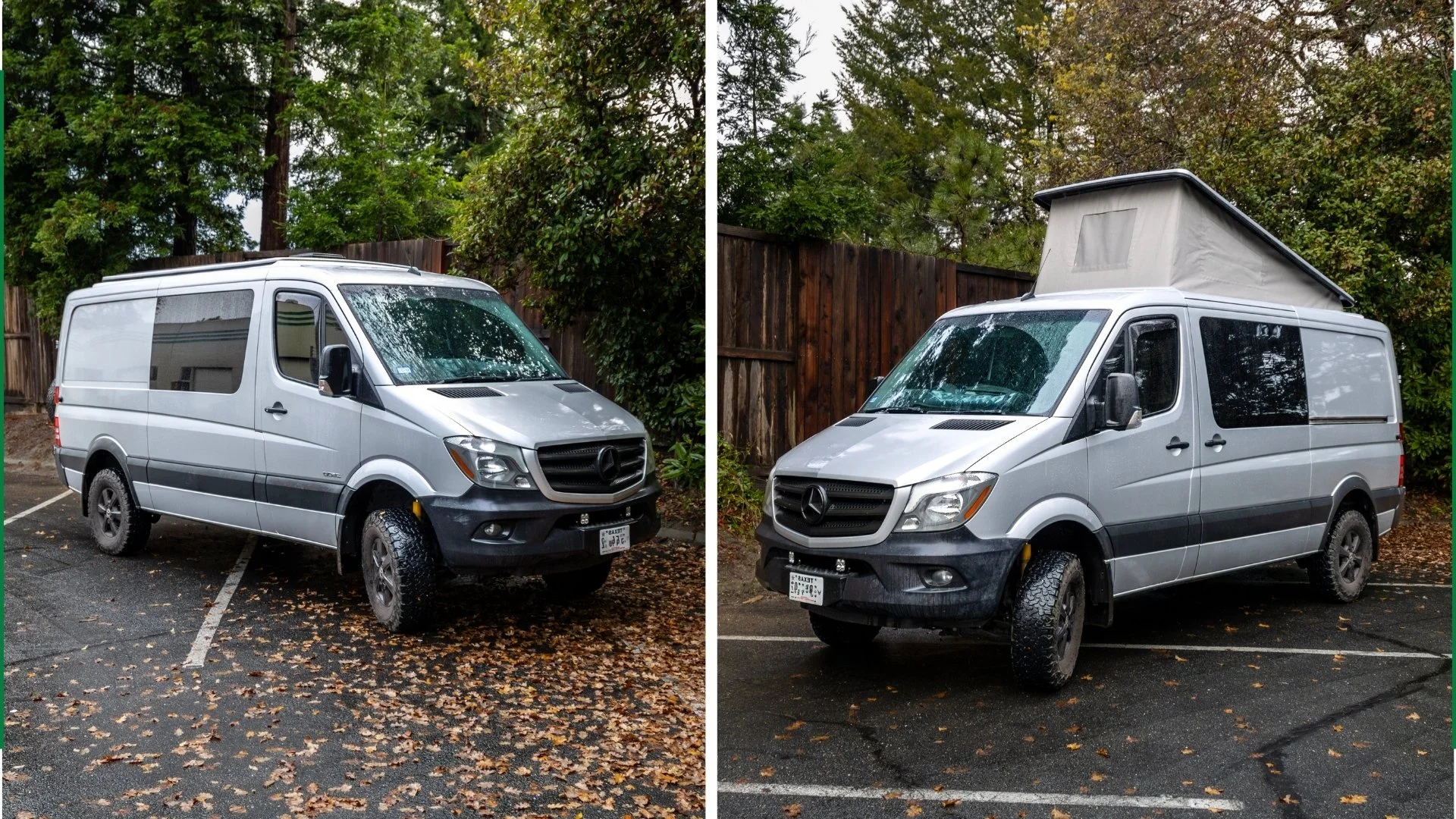
A pop top is an aftermarket modification. The roof of a low-roof van gets cut and fitted with a hinged panel that lifts up, usually adding three or more feet of headroom when raised, along with a sleeping platform in the raised section. When the top is down, the van looks more or less like a regular vehicle and drives at a standard profile.
Both give you standing room. Both work well for sleeping. But they get there in very different ways, and the tradeoffs show up in places people don't always think about in advance.
Standing Room, All the Time vs. When You Need It
The most obvious difference is when you have full headroom.
With a high roof, it's always there. You can stand up while driving to a new campsite (though you probably shouldn't) or walk around inside the van while it's parked at the trailhead. There's no setup involved. For people who spend longer stretches living in the van, or who move around a lot during the day between cooking, working, and relaxing, that constant headroom starts to feel less like a feature and more like the baseline.
With a pop top, headroom is something you deploy. You park, pop the top, and now you can stand. When you're driving or parked somewhere briefly, the ceiling is lower. For most people doing weekend trips or shorter runs, that's fine. You don't need to stand up while driving. And the pop top goes up in under a minute.
The question is really about your daily rhythm in the van. If you're going to be inside for hours at a stretch, cooking, reading, waiting out weather, permanent headroom changes the experience. If your pattern is more about sleeping in the van and spending the day outside, the pop top gives you what you need without the tradeoffs that come with a taller vehicle.
What Happens When You Get Home
This is the part that surprises people the most, and it's where we hear the most "I wish I'd thought about that" feedback.
A standard residential garage door opening is about 7 feet. A high-roof Transit is over 9 feet tall. A high-roof Sprinter is taller still. That means a high-roof van does not fit in most residential garages. Period.
For some people, that's completely fine. The van lives in the driveway, on the street, or at a storage lot, and that works for their situation. But for a lot of buyers, especially in neighborhoods with HOA restrictions, narrow streets, or limited driveway space, the "where does it live?" question is more complicated than they expected.
A pop-top van, with the top down, sits at the height of whatever the base vehicle is. A low-roof Transit with a GTRV pop top adds less than an inch to the overall height. It fits in a standard garage. It looks like a regular van from the outside. For people in tighter neighborhoods, or who want the van to double as a daily driver without drawing attention, that's a real advantage.
We've had customers tell us that garageability was the deciding factor. Not because they cared about the roof configuration on its own, but because the practical reality of living with a tall vehicle every day, not just on trips, was more of a factor than they'd realized.
If you haven't thought about this yet, it's worth measuring your garage door and checking any parking restrictions in your area before you get too far down the road.
How It Affects the Build
The roof decision doesn't just change the ceiling. It changes what's possible inside.
A high-roof van gives you a tall, continuous interior volume. That makes certain layouts easier. You can stack systems vertically. Overhead cabinets are more practical. Full-height closets, raised beds with usable storage underneath, tall pantries. The extra cubic footage opens up design flexibility, especially on full buildouts with a kitchen, bathroom, shower (possibly) and dedicated sleeping area.
With a pop top, the interior volume is more compact when the top is down, and the raised section adds a sleeping loft, or storage, when it's up. That sleeping loft is one of the real strengths of the pop-top design. It separates the bedroom from the living space, so you don't have to convert anything. The bed stays up top, and the lower level stays clear for other use.
Some customers never use the pop top for sleeping, deciding instead to use it strictly for standing room and for storage while camping.
But the lower ceiling when the top is down means the build needs to be more thoughtful about vertical space. Cabinets are shallower. Countertops sit lower. The overall feel is more compact. It works well, but it works differently, and the design needs to account for that from the start rather than treating it as a scaled-down version of a high-roof layout.
We've been building pop-top conversions for over 30 years, and the thing that makes them work is designing specifically for that form factor. A good pop-top layout isn't a compressed high-roof layout. It's its own thing.
Weight, Wind, and How It Drives
This gets less attention than it should.
A high-roof van has a permanently tall profile. That means more surface area for crosswinds, more aerodynamic drag, and more weight up high (the roof itself, plus anything you mount on it). On calm days, you don't notice much. On a windy day on an exposed highway, you notice.
High-roof vans also use more fuel. The taller profile creates more drag at highway speeds, and the extra weight of the taller body and the heavier build it enables adds up. It's not dramatic, but over a year of driving, the difference is real.
A pop-top van, with the top down, drives closer to a regular vehicle. Lower profile, less wind resistance, less weight. On the highway, the difference in how the van handles in crosswinds is noticeable, especially for people coming from cars or smaller vehicles.
When the pop top is up and you're parked, none of this matters. But when you're driving, which is a significant part of owning a camper van, the lower profile makes a difference in how the van feels behind the wheel.
Insulation and Weather
High-roof vans have solid, insulated walls and ceiling all the way around. You can insulate them to whatever standard you want (within reason). In cold weather, a well-insulated high-roof van with a good heater is a comfortable space.
Pop tops, by design, have a fabric or partially fabric section when the top is raised. Modern pop-top fabric is well-designed, but it's not the same as a solid insulated wall. In mild to moderate cold, most people don't notice a significant difference, especially with a heater running. In genuinely cold conditions (winter camping, mountain passes, below-freezing nights), the pop-top section is noticeably cooler than the rest of the van.
For three-season use, which is what most people actually do, the pop top works well. For people who plan to camp in serious cold regularly, the high roof has an advantage in terms of consistent insulation.
That said, most pop-top owners sleep in the lower portion of the van when it's cold and use the pop-top loft in warmer weather. The van adapts. It's just something to think about based on how and when you travel.
The Stealth Factor
If discretion matters to you (parking overnight in urban areas, not drawing attention, blending in), the pop top has a clear advantage. With the top down, the van looks like a work van or a family vehicle. It doesn't announce itself.
A high-roof van, especially one with visible build features like a roof rack, solar panels, or a fan, is recognizable as a camper. That may not matter depending on how and where you camp. But for people who plan to do any urban overnighting, or who just prefer not to have a vehicle that looks like an RV in their driveway, the lower profile of a pop top is a practical benefit.
Where GTRV Sits on This
We build both. Pop tops have been the core of GTRV's work for over 30 years, and they're still a big part of what we do. But we also build full high-roof conversions, and that side of the business has been growing, especially since the Mercedes Metris was discontinued. The Metris was a great mid-size platform for pop-top builds, and when it went away, some of that demand shifted toward larger platforms where high-roof versions are available.
We don't steer people toward one option or the other. We build whichever one fits the situation. That's partly because we've done both for long enough to know that the "right" answer genuinely depends on how someone plans to use the van, where it needs to park, and what kind of traveling they do.
Most shops lean one direction. They either specialize in pop tops or they build mostly high-roof conversions. That's fine, but it can color the advice you get. If all a shop builds is high-roof Sprinters, that's probably what they'll recommend. Same in reverse.
When we talk to someone early in the process, the roof question usually comes up naturally alongside the platform question. The two decisions are connected. A platform comparison helps, but it's not complete without thinking about the roof.
How to Think About the Decision
There's no formula. But there are a few questions that tend to make it clearer.
How much time will you spend inside the van on a typical trip? If the answer is "mostly sleeping and some meals," a pop top covers that well. If you're inside for long stretches, working, cooking, hanging out in bad weather, permanent headroom starts to matter.
Where will the van live when you're not traveling? If it needs to fit in a garage, or if you have parking restrictions, that may settle the question.
What's your travel pattern? Weekend trips and shorter runs favor the pop-top's versatility and lower profile. Extended travel and full-time use tend to lean toward the high roof's permanent livability.
How do you feel about driving a tall vehicle? Some people don't think about it twice. Others find it stressful, especially in cities, on mountain roads, or at gas stations with low canopies. A pop-top van drives like a normal vehicle.
How important is insulation and weather resistance? For three-season use, both work well. For serious cold-weather camping, the high roof has an edge.
None of these are dealbreakers in either direction. They're the kinds of things that help the right answer emerge based on your actual situation, rather than based on which looks better in photos.
If you're still sorting through the early decisions about platform and design priorities, The 80/20 Rule of Van Design is a good companion to this post. It gets at the same idea from a different angle: build for the life you'll actually live, not the one that looks best on a screen.
Want to talk it through?
The roof decision is one of those things that gets clearer once you talk it through with someone who's built both.
Most of these conversations start with the basics: how do you want to use your van? What makes sense for the way you actually travel? From there, we can start working toward the design choices that fit your life.
Call us at 888-332-9602 or send us a message here
Stay in the loop
Our newsletter is where we share what we're learning, thinking about, and building at the shop. Platform insights, practical advice, and the kind of detail that tends to matter more over time.
No hype. No spam. Just useful perspective from people who do this every day.
Subscribe to the GTRV newsletter
If you're still in research mode, these are good next steps:
A First-Time Buyer's Guide to Camper Vans
