
Is a Professional Van Conversion Worth It, or Should You Build Your Own?
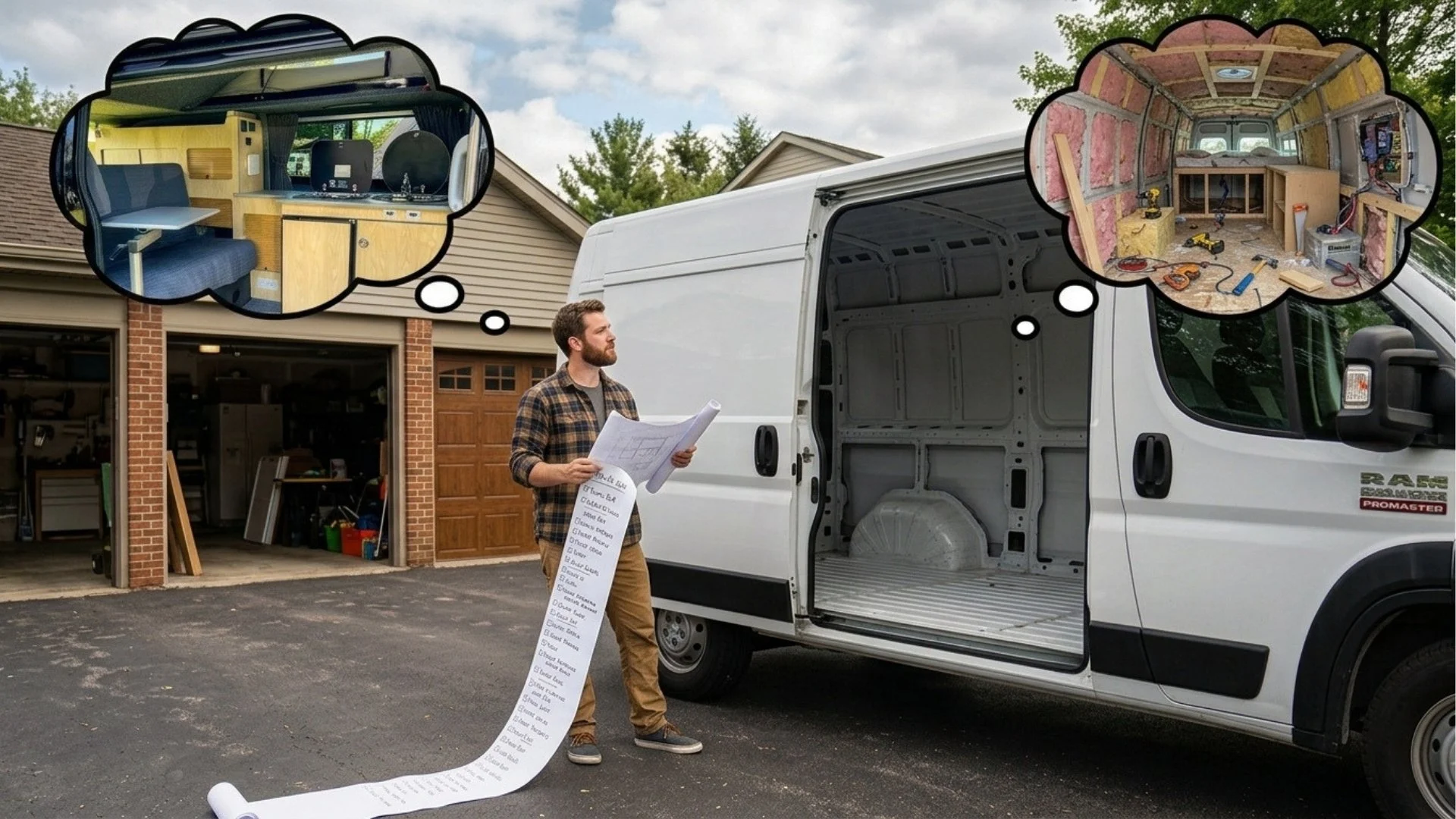
You've Seen the Price, and Now You're Doing the Math
Sooner or later, while you're pricing out a van, you hit the number. It's either a quote from a shop or a rough total you've added up on your own, and it's higher than you pictured. That's usually when you ask yourself, "Could I just do this myself for less?"
We hear this question more often than you'd think. We also see how it goes both ways, because a good number of the vans that come through our shop for service or upgrades started as someone's own build. Some of those builds are excellent. Others we end up redoing. What follows is our read on when each path makes sense.
Where the Cost Difference Comes From
Whether you convert it yourself or a shop does it, the cost of the van itself remains the same. The cost of the conversion is where there may or may not be an opportunity to save.
When you're looking at the project cost, it's important to realize that shops may be able to extend favorable material and appliance costs into the full cost of the build. More than the pricing, though, our parts list itself is the product of years of trial and error. Knowing which battery, charger, inverter, and fridge are reliable and work well together, and which combinations cause headaches, is its own kind of value that never shows up on an invoice.
The single biggest line item in a full conversion is going to be labor. So the money you save building it yourself comes mostly from sweat equity, your own labor. And sometimes the real cost is the time you spend learning as you go. Whether that trade off is worth it depends not only on your skill level, but also on how much of that time you have, and whether you'd rather be spending it on other things.
When Building It Yourself Is the Right Call
Plenty of people build their own vans and end up with something they love. If most of the following is true, DIY is worth a serious look.
You enjoy the work. For some people the build is part of the point, not an obstacle between them and the trip. If you'd find the process satisfying rather than exhausting, it could be a good move.
You have the time and the space. A first build almost always takes longer than people plan for. It's common to hear from someone who budgeted a few weeks and lost most of a year to it, working evenings and weekends around a job. One couple who documented their own conversion online took eight months, and the parts that nearly broke them were the electrical and the insulation, the two systems that are easiest to underestimate. A garage or covered area to work in helps a lot. If you're trying to be road-ready by a particular season, be honest with yourself about the timeline.
You're building a simpler van. A weekender with a bed, some storage, a fan, and a modest power setup is a very different project than a four-season, full-time rig with a large electrical system and plumbing. The simpler the build, the easier it is to learn on.
Where DIY Builds Tend to Get Expensive Later
The system that comes back to us most often is also the one whose problems stay hidden the longest: the electrical.
The trouble usually starts at the shopping stage. It's easy to buy piece by piece, a battery you like, then a charger, then an inverter, then solar, and end up with parts that don't quite match. A common mistake is buying an underpowered or budget inverter that runs the lights fine but won't drive a coffee maker or a power tool, or that kicks off the moment two or more loads come on at the same time.
Correctly choosing wire gauge is a big issue, because undersized wire can cause overheating and potential fire hazards. Knowing how to properly size wire, and when and where to add fusing, is very important when building out a conversion.
There's also a difference between parts rated for a house and parts that hold up in something that moves and vibrates all day. For example, we sometimes see solid core wire used for 110V circuits in a van. That wire is perfect for houses, but isn't the best choice for RV's. It's much safer, and easier, to use stranded, "Marine Grade" wire for that purpose in a van.
A setup like this usually works well the day it's finished, but starts having problems later. Those kinds of problems tend to be intermittent which can be frustrating and miserable to resolve on the road.
None of this makes DIY a bad idea. They're just the places where saving on labor up front can cost more to fix down the line.
The One Part We'd Tell You Not to Do Yourself
Pop-tops are our specialty, so read this knowing that. It's also the honest answer.
Installing a pop-top means cutting a large opening in the roof of the vehicle, fabricating and fitting fiberglass, getting the lift mechanism and strut geometry right so the top opens and seals correctly, and matching the paint. A mistake in cabinetry is a redo. A mistake in the roof is a leak in a structural part of the van, and it's not a forgiving thing to get wrong. If you want to understand what's involved, we walked through the whole process in What It Takes to Install a Pop Top.
This is the clearest line we'd draw. Build the interior yourself if you have the skills and the time. Leave the roof to a shop that does it regularly.
What You're Paying a Shop For
It helps to be clear about what the higher price buys, because it isn't a markup on parts.
You're paying for a layout that's been proven across many builds, one that uses the space well and has the day-to-day annoyances already worked out of it. You're paying for systems that work the day you pick it up, without a shakedown period spent troubleshooting your own wiring. And you're paying for one place to call when something needs attention two or five years in, which is more important than people expect. A lot of what comes back to us for upgrades and service is the fine-tuning that only shows up after real use.
So Which One Fits You
There's no clean rule, and the answer depends on two things: how you plan to use the van, and what your own time is worth to you. Someone who enjoys the work and is building a simple weekender is often well served doing it themselves. The case for a shop gets stronger the more you're asking from the van, and it's non-negotiable if you want a pop-top. Most people land somewhere in the middle. If that's you, the move is to get clear on how you'll really use the van before you spend anything, because that's the decision every other cost flows from.
If you're still sorting out the earlier questions, A First-Time Buyer's Guide to Camper Vans and The 80/20 Rule of Van Design are both good places to keep reading.
Still deciding whether to build it yourself or have it built?
If you're weighing options or just want to think out loud with someone who does this every day, we're happy to help.
Most of these conversations start the same way yours probably would: “What's the benefit of having you build it instead of doing it myself?” That's the right place to start.
Call Joseph at 888-332-9602 or send us a message here and he’ll get back to you.
Stay in the loop
Our newsletter is where we share what we're learning, thinking about, and building at the shop. Platform insights, practical advice, and the kind of detail that tends to matter more over time.
No hype. No spam. Just useful perspective from people who do this every day.
Subscribe to the GTRV newsletter
If you're still in research mode, these are good next steps:
Before the Build, There's a Conversation
A First-Time Buyer's Guide to Camper Vans
The 80/20 Rule of Van Design: Build for the Life You'll Actually Live
